Ruskin said: " Great nations write their autobiographies in three manuscripts, the book of their deeds, the book of their words and the book of their art. Not one of these books can be understand unless we read the two others, but of the three the only trustworthy one is the last."
But thinking about ths almost incredible episode does tell one something about the nature of civilisation. It shows that however complex and solid it seems, it is actually quite fragile. it can be destroyed.
people sometimes feel disappointed the first time they see the famous beginning of Renaissance architechture...... They don't try to impress us or crush us by size and weight, as all God-directed architechture does. Everything is adjusted to the scale of reasonable human necessity. They are intended to make each individual more conscious of his powers, as a complete moral and intellectual being. They are an assertion of the dignity of man.
So if one asks why the civilisation of Greece and Rome collapsed, the real answer is that it was exhausted.
People sometimes tell me that they prefer barbarism to civilisation. i doubt if they have given it a long enough trial. Like the people of Alexandria they are bored by civilisation; but all evidence suggests that the boredom of barbarism is infinitely greater. Quite apart from discomforts and privations, there was no escape from it.
Civilized man, or so it seems to me, mustfeel that he belongs somewhere in space and time; that he consciously looks forward and looks back.
It was achieved by fighting. All great civilisations, in their early stages, are based on success in war.
But historical judgments are very tricky. Maybe the tension between the spiritual and worldly powers throughout the Middle age was precisely what kept European civilisation alive.
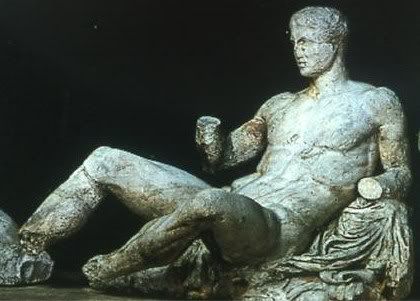
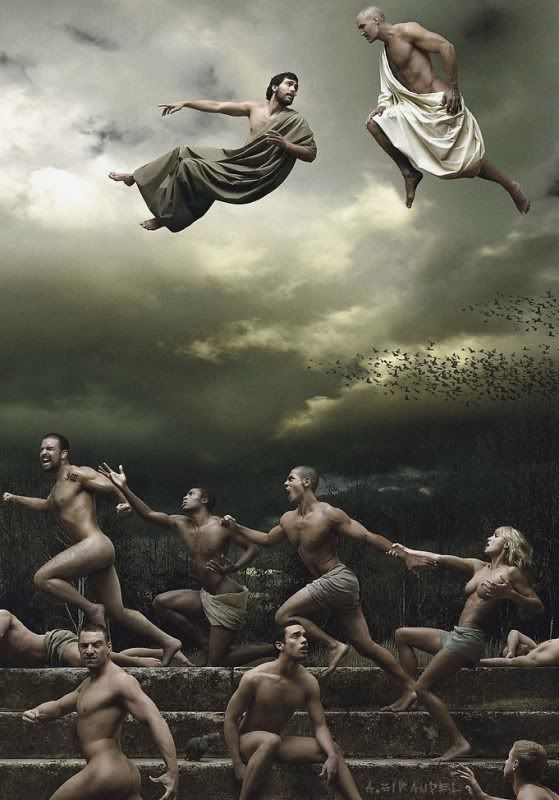
In naturalistic terms, as bodies, they are impossible, and the fact that one believes in them is a triumph of art.
Think of the people we encountered in the ninth and tenth centuries: vigorous, passionate, earnestly striving towards some kind of intellectual light, but fundamentally still barbarians..
Inside there is no trace of difficulty or calculation: the whole harmonious space seems to have grown up out of the earth according to some natural law of harmony.
The early Florentine Renaissance was an urban culture. Men spent their time in the streets and squares, and in the shops.
why it was in Florence and not elsewhere that men became perfect in the arts,...' the spirit of criticism: the air of Florence making minds naturally free, and not content with mediocrity.'
Our contemporary attitude of pretending to understand works of art in order not to appear philistines would have seemed absurd to the Florentines. They were tough lot.
whereas the Athenians loved philosophical argument, the Florentines were chiefly interested in making money and playing appalling practical jokes on stupid men.
They were curious, they were extremely intelligent, and they had, to supreme degree, the power of making their thoughts visible.
there was one of the weaknesses of Renaissance civilisation.it depended on a very small minority.
But one can't help wondering how far civilisation would have evolved if it has been entirely dependent on the popular will.
This is no longer a world of free and active men, but a world of giants and heroes.