
Monday, September 5, 2011

Ouroboros
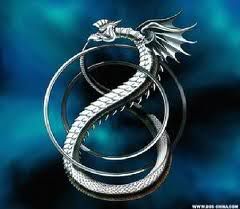
The Ouroboros is an ancient symbol depicting a snake eating its own tail.
Plato described a self-eating, circular being as the first living thing in the universe—an immortal, mythologically constructed beast.
“The living being had no need of eyes when there was nothing remaining outside him to be seen; nor of ears when there was nothing to be heard; and there was no surrounding atmosphere to be breathed; nor would there have been any use of organs by the help of which he might receive his food or get rid of what he had already digested, since there was nothing which went from him or came into him: for there was nothing beside him. Of design he was created thus, his own waste providing his own food, and all that he did or suffered taking place in and by himself. For the Creator conceived that a being which was self-sufficient would be far more excellent than one which lacked anything; and, as he had no need to take anything or defend himself against any one, the Creator did not think it necessary to bestow upon him hands: nor had he any need of feet, nor of the whole apparatus of walking; but the movement suited to his spherical form was assigned to him, being of all the seven that which is most appropriate to mind and intelligence; and he was made to move in the same manner and on the same spot, within his own limits revolving in a circle. All the other six motions were taken away from him, and he was made not to partake of their deviations. And as this circular movement required no feet, the universe was created without legs and without feet.“
The Ouroboros often represents self-reflexivity or cyclicality, especially in the sense of something constantly re-creating itself, the eternal return, and other things perceived as cycles that begin anew as soon as they end (the mythical phoenix has a similar symbolism). It can also represent the idea of primordial unity related to something existing in or persisting before any beginning with such force or qualities it cannot be extinguished.
「這頭生物並不擁有眼睛,因為在牠的外圍已經沒有任何需要觀望的東西存在;牠亦沒有耳朵,因為外圍沒有任何需要聆聽的事物;外圍沒有任何的氣息,所以牠不用呼吸;牠沒有任何的器官,因為在牠身邊沒有任何東西會被牠吸進或由牠排泄,所以不需要進行任何消化。在牠被生育出來的時候,牠的排泄物就安排成為牠的食糧,牠的行為及其行為之影響都源於牠,亦受之於牠。造物者構想出這頭能夠自給自足的生物,這比其它缺乏一切東西的生物來得完滿。另外,牠不需要向任何對象採取任何防衛的措施,造物者認為沒有必要給予任何獻牲到牠的手上。牠亦沒有足與腳,牠的整體本來就是一種移動的手段。牠雖然擁有無上的心靈與智慧,但牠對移動的概念卻相當模糊,因為牠只在同一個位置上存在,所以牠的移動軌跡有如圓球;可是隨著牠本身的局限,牠只能不住地環狀旋轉著。」
——柏拉圖
銜尾蛇亦代表了「自我參照」或「無限循環」,尤指那些能恆常自我增生的事物,以及循環周期性的自我發展,其中一個好例子就是傳說中的不死鳥,牠在自我焚滅的過程中自我繁衍(或理解為「重生」),正是無限循環概念的一種表現。另外,銜尾蛇亦象徵着最原始的元素。
那些透過自己的方法,以比現世更甚的程度去探索自然,從而深入了解萬物的煉金術士們,以銜尾蛇──那條咬著自己尾巴的蛇──的標誌解說這個矛盾的悖論(指銜尾蛇進行自我傷害這個古怪的現象)。銜尾蛇,早就被指是象徵著「無限」或者「一切」,在古代的印象中銜尾蛇具有「自我摧毀」及「轉化為循環模式」的含意,這對很多敏銳的煉金術士來說是清楚不過的訊息,他們理解煉金術的基礎是「第一元素」(Prima materia)。他們認為銜尾蛇是一個戲劇性的標誌,既能統合又能同化對立面;而經過這個自我統合同化的過程所得到的回饋,就是永生。因為銜尾蛇一方面在消滅自己,同時又在給予自己生機,牠孕育著自己,從而令自己得到生命。因此,銜尾蛇象徵著一個透過與對立面發生衝突而存在的原則,這正是構成第一元素的最佳演繹……(煉金術士們)從其它人的模糊概念中(指一般人對銜尾蛇的理解往往含糊隨意)得到清晰的答案。
you’re constantly recreating yourself, but mostly using the same materials you’ve used all along; that translates to very little substantial evolution.
Subscribe to:
Comments (Atom)